Warm up with this wall pass drill
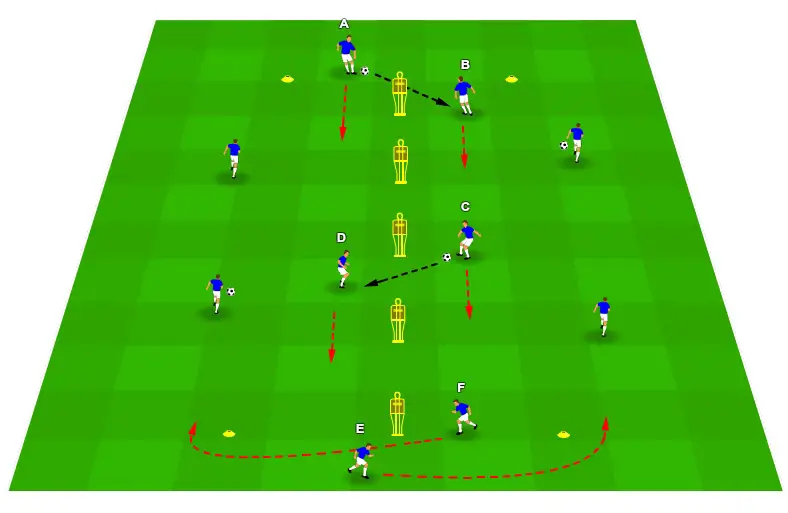
This wall pass drill gives adult amateur teams a simple warm-up for practising wall passes, passing accuracy, timing and acceleration into the space beyond a defender.
Setup
Use enough space for players to work through the passing sequence. Use 4 cones to mark the working area and arrange a minimum of 3 mannequins as shown in the diagram.
The drill can run with as few as 2 players. For larger groups, set up two or more working areas or add more mannequins so players are not waiting in long lines.
If mannequins are unavailable, use cones, chairs or teammates standing in as defenders.
Equipment Needed
- At least 6 balls
- 4 cones
- At least 3 mannequins
Rules & Instructions
Use the passing pattern to combine around each mannequin and attack the space beyond it.
- Player A passes to Player B and runs beyond the first mannequin.
- Player B passes behind the mannequin into Player A’s run.
- Repeat the wall-pass sequence at every mannequin.
- After Player A receives beyond the last mannequin, switch lanes and sprint back.
- Start the next pair after the previous pair passes the second mannequin.
- Use only 2 touches: receive and pass.
- Continue without stopping for 10–15 minutes.
Coaching Tips
- Start slowly, then increase the intensity as players settle.
- Demand accurate passes into the teammate’s path.
- Accelerate immediately after every pass.
- Time each run to keep the return pass available.
- Use lane switches to work on body shape from both sides.
- Increase speed without sacrificing passing accuracy.
Why It Works for Adult Amateur Teams
Wall passing teaches players to move after releasing the ball and exploit the space behind a defender. Repeating the combination around the mannequins links passing accuracy, timing and acceleration in a simple sequence that reflects give-and-go movements used across the pitch.
For adult amateur teams, the pattern is easy to organise with a small group and can expand across additional working areas when more players attend. The repetition also makes it easier for coaches to identify slow movement, poor timing and inaccurate return passes before increasing the intensity.
Key Outcomes:
- Better passing accuracy
- Sharper acceleration after passing
- Improved timing
- Stronger team coordination
Related Posts
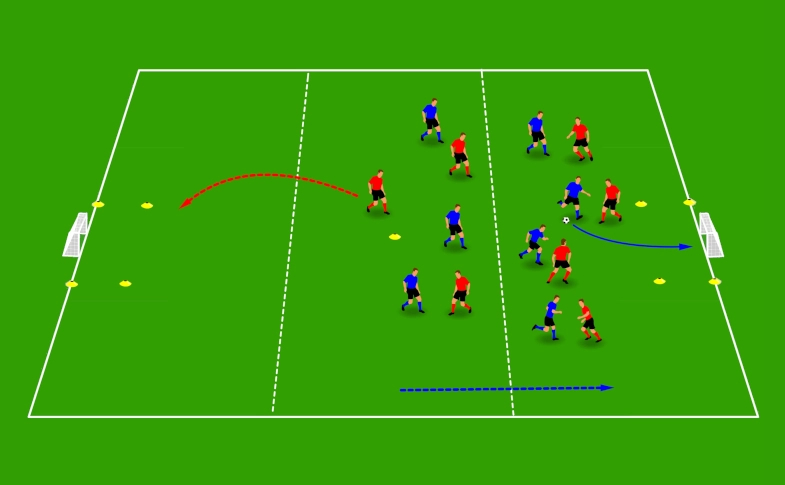
Block Movement Drill: 7v7 Game
A 7v7 block movement drill that helps adult amateur teams stay connected, move up together, and react quickly when possession changes.
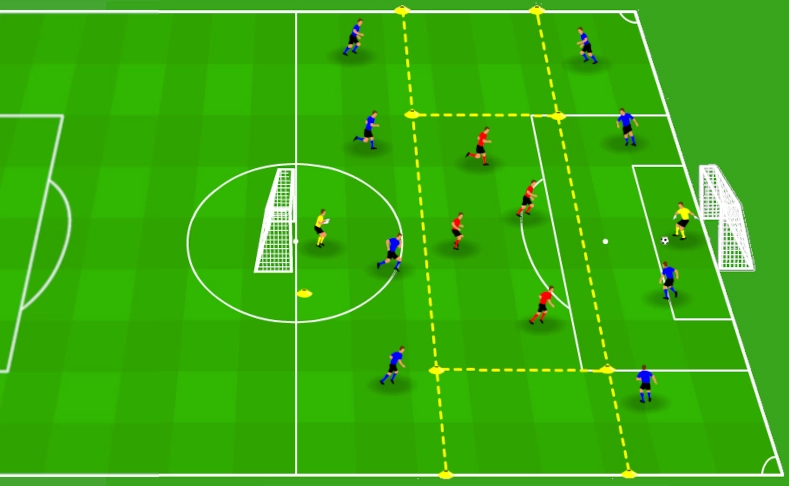
Back Four Exit - Defenders vs Midfield and Attack
A Back Four Exit drill for adult amateur teams, training build-up play, pressing, switching play, transitions, and finishing in a zoned half-pitch setup.
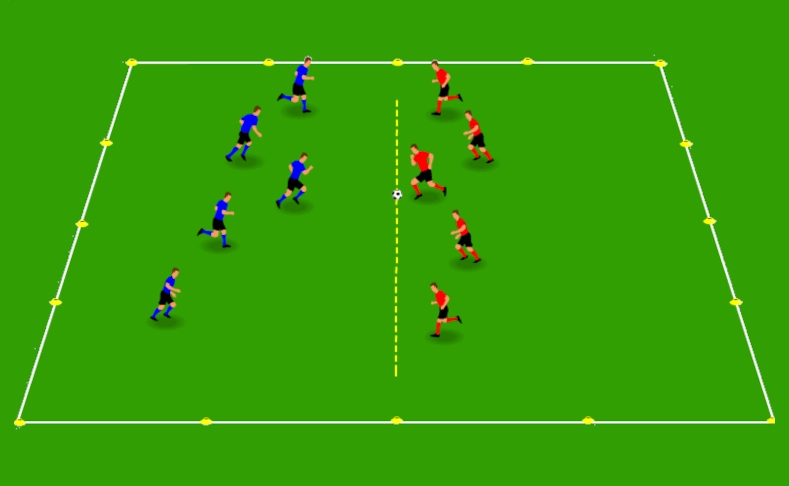
Spatial Awareness Drill: Football with Rugby Rules
Train spacing, patience, support angles, and communication with a football drill that uses rugby-style offside rules and a controlled goal-line finish.