Goalkeeping drill: Stop and Distribute
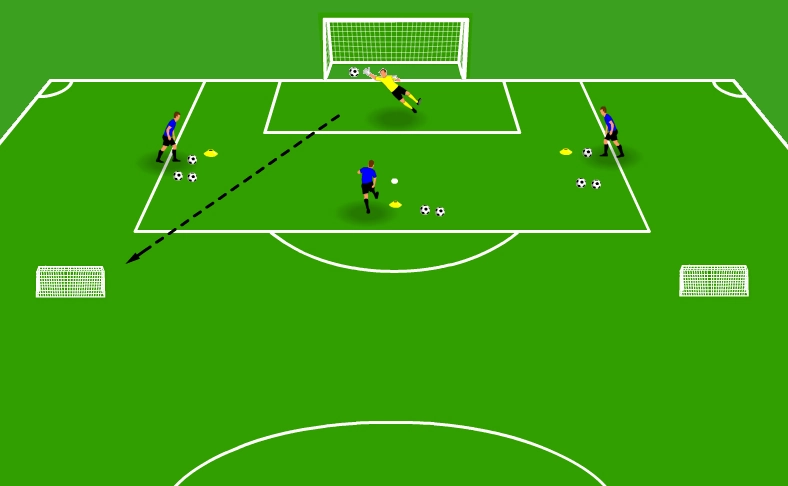
This goalkeeping drill helps adult amateur teams train shot-stopping, recovery, and quick distribution in one competitive practice. The goalkeeper faces repeated shots, then looks to control the ball and distribute accurately into small target goals.
Setup
Use one goal on an 11-a-side pitch or a portable full-size goal with enough space around the penalty area.
Place the small goals just outside each corner of the penalty box, in the kind of wide position where a fullback might start an attacking run.
Use cones to mark the shooting stations inside the penalty box, about half a metre inside the box, as shown in the drill image.
Set up with two shooters and one goalkeeper. The goalkeeper works in the main goal, while the shooters take turns from the marked shooting stations.
Equipment Needed
- 1 full-size goal
- At least 12 balls
- 2 small goals
- Several cones
Rules & Instructions
Run the drill as a fast shot-stopping and distribution competition.
- Start with the goalkeeper in goal and shooters at their stations.
- Each shooter takes one turn at goal.
- The shooter must call their name before shooting.
- Shooters may strike from the ground or use a drop-kick.
- Shooters must wait until the goalkeeper’s hands are empty.
- The goalkeeper tries to stop and control each shot.
- After controlling the ball, the goalkeeper throws into a small goal.
- Award the goalkeeper 1 point for a save.
- Award the goalkeeper 1 extra point for distributing into a small goal.
- Award the shooter 1 point for each goal.
- Allow a rebound shot only if the ball returns clearly to the shooter’s station.
- Restart from the next shooter after each goal, save, miss, or distribution.
- Remove 1 point if a shooter strikes without calling their name.
- Remove 1 point if a shooter shoots while the goalkeeper holds a ball.
- Remove 1 point from both shooters if they shoot together.
- Play for a set time, such as 10 minutes.
- The player with the most points wins.
Coaching Tips
- Tell the goalkeeper to set early before each shot.
- Adjust the keeper position if they stand too deep or too high.
- Secure the ball before distributing.
- Recover quickly after saves and rebounds.
- Aim throws into the small goals, not just away from danger.
- Keep shooters disciplined with clear communication.
- Use a short practice round to explain the scoring.
- Stop briefly if the rules become messy.
Why It Works for Adult Amateur Teams
This drill connects two goalkeeper actions that often happen together in matches: making a save and restarting the attack. Instead of treating distribution as a separate technical exercise, the goalkeeper has to distribute after reacting to a shot.
That makes the practice useful for adult amateur teams, where goalkeepers often face pressure, loose rebounds, and rushed restarts. The small goals give the goalkeeper a clear distribution target and help make the action measurable.
The competitive scoring also keeps the shooters engaged. They practise striking from penalty-area positions, while the goalkeeper works on reactions, handling, recovery, communication, and decision-making under pressure.
Key Outcomes:
- Sharper shot-stopping reactions
- Better goalkeeper positioning
- Quicker recovery after saves
- More accurate goalkeeper distribution
- Stronger communication under pressure
The video below shows a similar goalkeeper training rhythm, with repeated shots, quick reactions, and distribution actions under pressure.
Related Posts
Goalie Tips - Preparation on Corner Kicks
Corner kicks are one of the most dangerous situations in a football game. These quick goalie tips will help you to be more effective at corner kicks.
Goalkeeper distribution drill - Strikers vs goalie
This post describes a goalkeeper distribution drill that will help your keeper transition from defence into attack quickly and accurately.
5 Goalkeeper Attributes Every Keeper Must Have
A great goalkeeper is a key differentiator among football teams. This post discusses five goalkeeper attributes that modern keepers share.