Switching Play Drill - Break Blocks Fast
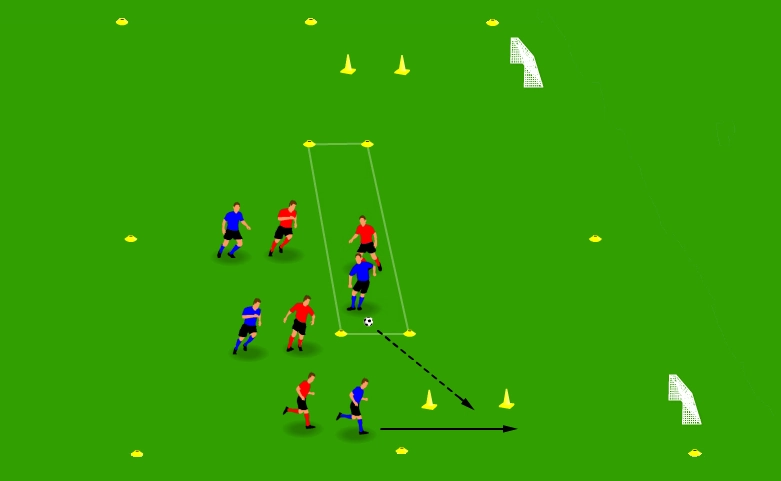
This switching play drill helps adult amateur teams break compact blocks by using a central pivot, diagonal passes, weak-side attacks, and quick finishes before defenders recover.
Setup
Mark a rectangle roughly half-pitch in size, or use one half of an actual pitch. Create a 10-metre-long central pivot zone with flat cones.
Place two small goals on the same end of the rectangle, one close to each sideline. Add two tall cones or poles about three metres infield from each goal to create the diagonal target gates.
Set up eight players in a 4v4. Use one team as the attackers and one team as the defenders. Assign one attacking player as the pivot and one defender to stay inside the central pivot zone.
Equipment Needed
- 12 flat cones
- 4 tall cones or agility poles
- 2 small goals
- Minimum 3 balls
- 8 training vests, 4 per colour
Rules & Instructions
Use the flow below to draw pressure, find the pivot, and switch into space.
- Start each round with attackers in possession.

- One attacking pivot and one defender stay in the central pivot zone.
- All other players stay outside the pivot zone.
- Attackers make 3 passes before playing into the pivot.
- Defenders press as a compact block and try to stop the switch.
- The pivot can switch through either gate or recycle possession.
- If the pivot recycles, attackers restart the 3-pass sequence.
- To score, the pivot must pass through a gate before the finish.
- After the switch, defenders can recover to stop the wide attacker.
- The wide attacker has 2 touches to shoot.
- After a goal, possession stays with the attacking team.
- Possession changes only if defenders win controlled possession.
- A clearance, block, or deflection alone does not win possession.
- Play first to 10 goals or 10 minutes.
The animation below shows the drill flow more clearly.
Coaching Tips
- Cue attackers to scan before pass 3.
- Coach the pivot to receive side-on.
- Demand firm diagonal passes through the gate.
- Ask wide players to set their first touch early.
- Keep defenders sliding as a compact unit.
- Check spacing so the switch has value.
- Stop play if teams switch before pass 3.
- Demand quick recovery after the switch.
Why It Works for Adult Amateur Teams
Adult amateur teams often struggle to break compact blocks because play becomes crowded on one side. This switching play drill trains players to move the defence across, use the pivot, and attack the far side before the block can recover.
The pattern is simple enough to run with a small group, but it still includes realistic decisions. The pivot must decide whether to switch or recycle, the wide player must control and finish quickly, and the defenders must recover after being stretched.
It also gives coaches a clear view of timing, spacing, scanning, and diagonal passing quality. If the switch is forced too early or played too slowly, the problem is easy to spot and correct.
Key Outcomes:
- Faster switches of play
- Cleaner pivot decisions
- Better weak-side attacks
- Stronger recovery defending
- Quicker finishes after switches
Related Posts
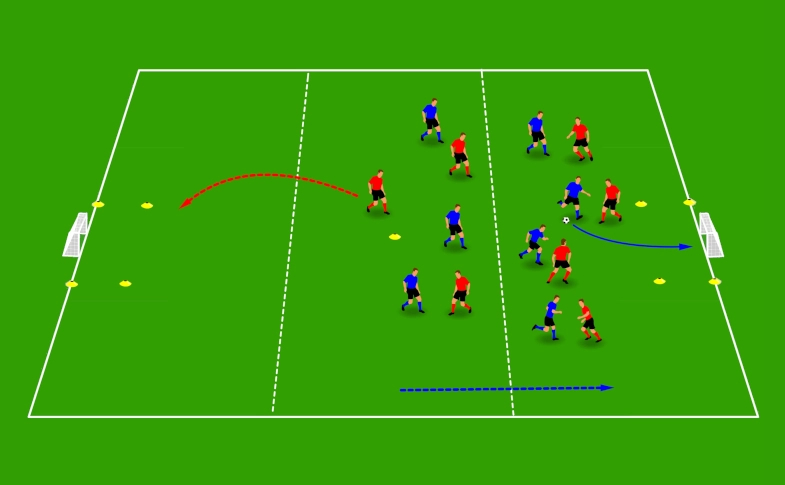
Block Movement Drill: 7v7 Game
A 7v7 block movement drill that helps adult amateur teams stay connected, move up together, and react quickly when possession changes.
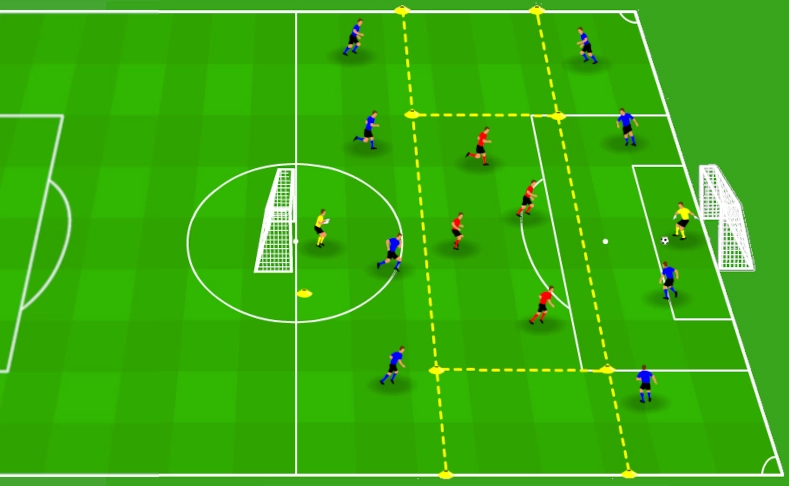
Back Four Exit - Defenders vs Midfield and Attack
A Back Four Exit drill for adult amateur teams, training build-up play, pressing, switching play, transitions, and finishing in a zoned half-pitch setup.
Spatial Awareness Drill: Football with Rugby Rules
Train spacing, patience, support angles, and communication with a football drill that uses rugby-style offside rules and a controlled goal-line finish.